



When a manufacturing business owner first calls us, they usually say one of two things.
Either: “We’ve been doing digital marketing for a year, and we’re not getting any leads.”
Or: “We’ve never tried digital marketing — we don’t even know where to start.”
Both situations are more common than you’d think. And both have a clear solution.
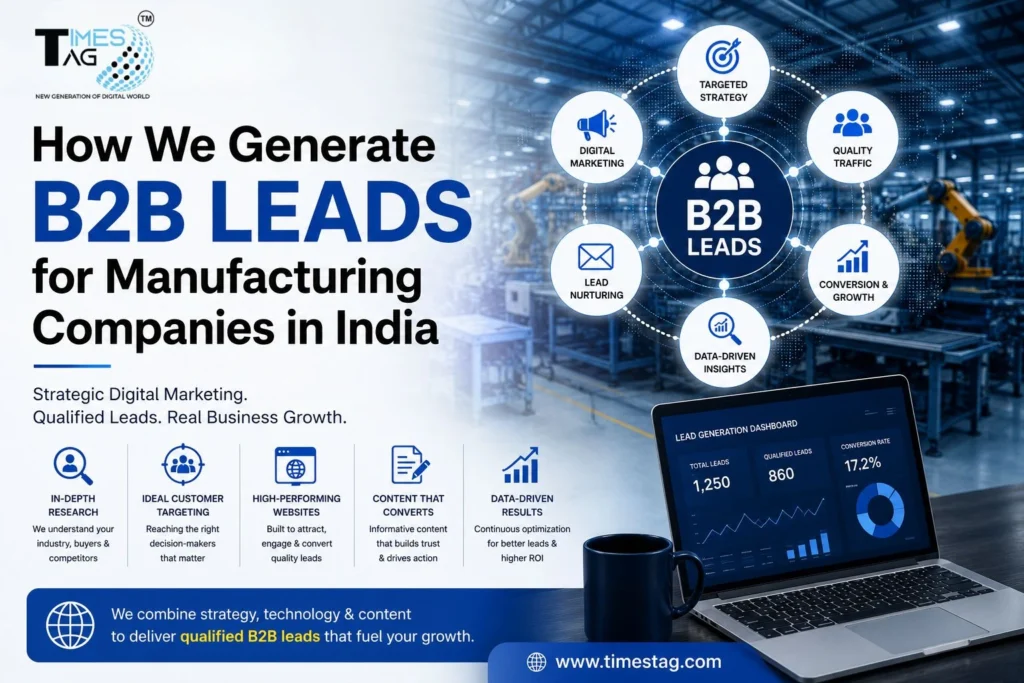
This blog is not a vague overview of “what digital marketing can do for manufacturers.” This is the actual, step-by-step process we use at Times Tag — the steps we take, the tools we use, and the results we’ve seen for industrial clients like Airmax Pneumatics, Cair Euromatic, and Advance Biofuel.
If you’re a manufacturing company in India wondering how to generate more B2B enquiries through digital channels, read this carefully.
Why B2B Lead Generation for Manufacturers Is Different
Before we get into the process, let’s talk about why manufacturing lead generation is different from other industries, because this distinction matters enormously.
In B2C marketing, you’re trying to trigger an impulse. Someone sees your ad, feels something, clicks, and buys. The whole journey can happen in minutes.
B2B manufacturing is the opposite. As Rajesh R Nair’s B2B Digital Marketing guide explains: “A B2B buyer evaluating a ₹15 lakh annual subscription will take 30 to 180 days, involve 4 to 7 stakeholders, and require multiple approval layers before a purchase order is raised.” For manufacturing, where product complexity and order values are even higher, this timeline can be longer.
OneMagnify’s B2B Digital Marketing Trends 2026 report adds critical context: “Many buyers are already 60–70% through their decision-making process by the time they reach out to a vendor.” This means your digital marketing has to do a very different job; it’s not about generating clicks. It’s about building trust with technically-minded buyers throughout a long research journey and ensuring you’re visible and credible at every stage.
Additionally, a March 2026 Gartner report cited by Danetsoft found that 67% of B2B buyers now prefer a rep-free buying experience, meaning most of the supplier evaluation is happening online silently before your phone ever rings.
With that context in mind, here’s our exact process.
Step 1: Fix the Website — The Foundation Everything Else Rests On
This is the first thing we do with every manufacturing client, and it often surprises them.
Most manufacturing companies assume they need more traffic. What they actually need first is a website worth sending traffic to. Because if your website is slow, hard to navigate, or doesn’t build trust, all the SEO and ads in the world won’t generate enquiries. The traffic arrives, looks around for a few seconds, and leaves.
Danetsoft’s industrial SEO guide identifies the key issues clearly that manufacturing websites commonly suffer from “slow pages, broken links, poor mobile layouts, and crawl errors” that kill both rankings and conversions.
Here’s what we audit and fix:
Speed: Manufacturing websites are notorious for being slow — loaded with heavy PDFs, large uncompressed images, and outdated code. ACSIUS’s 2026 Industrial SEO Guide confirms that page speed and Core Web Vitals are key ranking factors in 2026. A page that takes more than 3 seconds to load loses a large share of visitors before they even see your content.
Mobile Optimization: ACSIUS is emphatic on this: “Even in B2B industries, many users browse on mobile devices. A mobile-friendly website improves user experience and is a key ranking factor.” If your website looks broken on a phone screen, it signals to both the buyer and Google that your business isn’t serious.
Trust Signals: Does your website show certifications, years of experience, key clients, and past projects? Does it have real photos of your factory? Mocaup’s B2B Digital Marketing guide for 2026 notes that Indian B2B buyers specifically respond to localized case studies and real proof — and that a “dynamic landing page showing manufacturing-related results converts far better” than a generic homepage.
Clear CTAs: Every product page should have one clear next step — “Request a Quote,” “Talk to Our Engineer,” or “Download Product Spec Sheet.” Most manufacturing websites bury their contact information or don’t have a WhatsApp option — a major conversion gap in the Indian market.
We don’t move to the next step until the website foundation is solid. A leaky bucket doesn’t hold water, no matter how much you pour in.
Step 2: Target Buyer-Intent Keywords, Not Just Brand Keywords
Once the website is ready to convert, we build the SEO strategy — and this is where most agencies get it wrong for manufacturing clients.
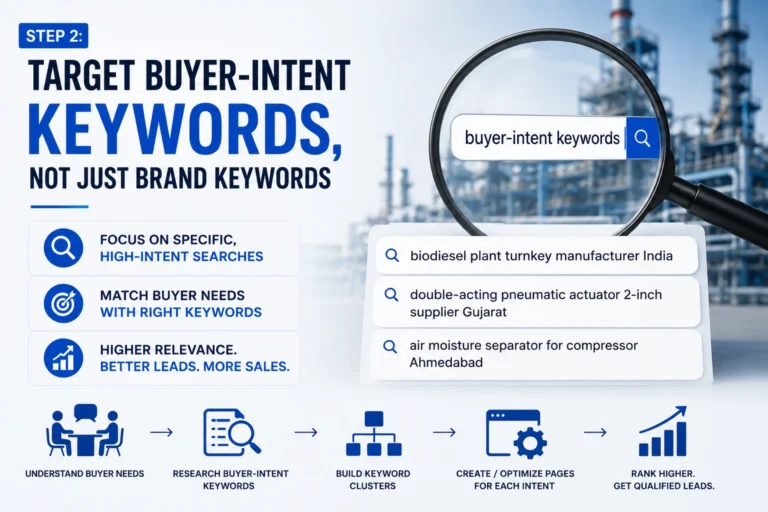
The instinct is to rank for broad, high-volume terms like “manufacturer India” or “industrial equipment supplier.” Sana Commerce’s SEO guide for manufacturers identifies this as a key mistake: “Overlooking no-to-low monthly volume keywords is a missed opportunity. While search volume may be lower, these keywords often have higher commercial intent — they attract users who are actively looking to make purchasing decisions.”
The Smarketers describe this more specifically: “Manufacturing SEO is specification-led. Buyers search for specific performance attributes, material properties, compliance certifications, and application requirements.” This means real buyers type things like:
- “biodiesel plant turnkey manufacturer India”
- “double-acting pneumatic actuator 2-inch supplier Gujarat”
- “air moisture separator for compressor Ahmedabad”
Our process involves sitting with the client’s sales and technical team to map out every product, every application, every specification, and every type of buyer. We then build a keyword architecture and create or optimize pages to rank for each of those searches. As Nopio’s manufacturing SEO guide advises: “Your sales and engineering teams hold valuable keyword intelligence. Ask them what questions prospects ask most frequently — these questions translate directly into search queries.”
mktgessentials adds a structural insight: the best approach is to build “keyword clusters — groups of topically related keywords mapped to individual pages” — so each page builds strong equity rather than having multiple pages compete against each other and dilute your overall SEO.
Step 3: Google Ads for High-Intent Buyers — Right Now
SEO is a long-term investment. But most manufacturing businesses need leads while the SEO strategy is being built. That’s where Google Ads comes in.
We run tightly targeted Search Ad campaigns focused on exactly the same buyer-intent keywords as our SEO strategy. As Mocaup’s B2B guide explains: “B2B SEO and content strategies take 4 to 6 months to show significant organic growth. However, paid campaigns on Google can start generating leads within the first 30 days.”
For manufacturing companies, Google Ads works best when:
- Campaigns are tightly focused on specific products and applications — not broad categories
- Ad copy speaks directly to the buyer’s technical need and mentions key differentiators (certifications, project scale, years of experience)
- Landing pages are highly relevant to the ad — a click on “pneumatic cylinder supplier Ahmedabad” should go to a dedicated page about pneumatic cylinders in Ahmedabad, not your generic homepage
- Budget is allocated based on the value of the enquiry — even a modest daily spend can generate high-quality leads with precise targeting
DemandSage notes that more than 80% of B2B marketers believe SEO generates better quality leads than PPC — which is why we always build SEO alongside Ads, not instead of it. Ads bring leads today; SEO builds the pipeline for tomorrow.
Step 4: Local SEO — Dominate City + Product Searches
For most Indian manufacturers, local and regional buyers represent their most accessible market. And Local SEO is the most underutilized opportunity in industrial digital marketing.
A B2B SEO specialist on Vocal/Geeks who has worked with multiple manufacturers in Gujarat states directly: “I have also worked with many manufacturers in Gujarat to boost their traffic and help them generate quality leads by focusing on locally-based keywords.” They highlight that having factories in specific industrial zones should be treated as an SEO asset — not just a logistical detail.
The manufacturing SEO specialist at HireSEOPro reinforces the trust dimension: “Your factory location builds trust. Even US buyers check whether a manufacturer looks real. Local authority strengthens global SEO.”
Our Local SEO process for manufacturing clients includes:
- Google Business Profile optimization: Full setup with product categories, factory photos, service areas, business hours, and regular updates
- Review generation: We help clients build a simple, repeatable system to request reviews from satisfied customers — because nothing builds credibility faster than verified testimonials
- Location-based keyword integration: Adding city and region-specific terms naturally throughout the website and product pages
- Local citation building: Ensuring accurate, consistent listings across industrial directories and B2B platforms
For clients like Cair Euromatic and Airmax Pneumatics, Local SEO has been one of the most consistent and immediate sources of new enquiries.
Step 5: WhatsApp and Enquiry Form Conversion Optimization
This step is often overlooked — and it’s where many manufacturing websites silently lose leads they actually earned.
A buyer has done their research. They’ve landed on your website, they like what they see, and they’re ready to enquire. Then they hit a clunky contact form, or they can’t find a phone number, or the form goes to an email inbox that nobody checks for 48 hours.
Lead lost. Forever.
Rajesh R Nair’s B2B digital marketing guide for India makes this point emphatically: “WhatsApp is not a casual communication channel in Indian business — it is a primary one. Decision-makers routinely conduct procurement conversations over WhatsApp. Integrating WhatsApp Business API into your lead nurturing flow significantly improves response rates compared to email-only sequences.”
Mocaup’s B2B agency guide further highlights how Indian B2B buyers are “famously value-conscious” — and that the buying decision is often made based on the first impression of your digital responsiveness. A slow response to an enquiry is interpreted as a slow business.
Our conversion optimization process includes:
- Simplifying contact forms to reduce friction — name, number, and one specific question, not a 10-field form
- Adding a WhatsApp Business button to every key product page
- Setting up automated acknowledgment messages so enquirers know their message was received
- Ensuring every digital enquiry receives a response within 4 hours — because in B2B, speed of response is a competitive advantage
Real Results: What This Process Has Delivered
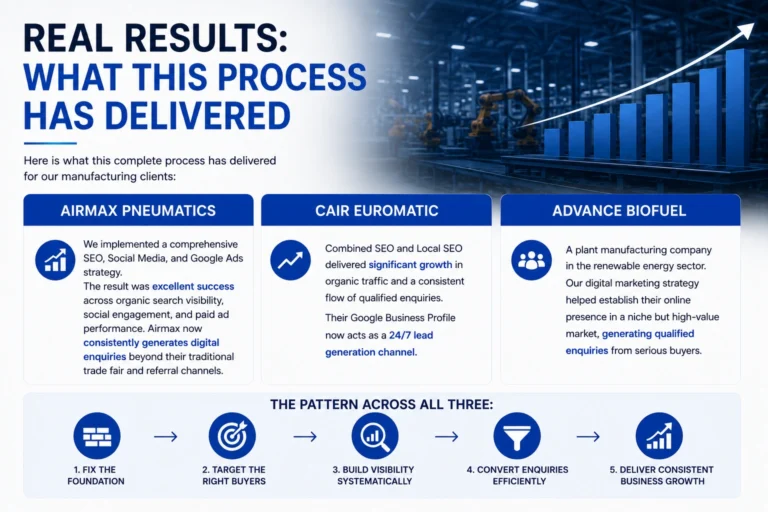
Here is what this complete process has delivered for our manufacturing clients:
Airmax Pneumatics: We implemented a comprehensive SEO, Social Media, and Google Ads strategy. The result was excellent success across organic search visibility, social engagement, and paid ad performance. Airmax now consistently generates digital enquiries beyond their traditional trade fair and referral channels.
Cair Euromatic: Combined SEO and Local SEO delivered significant growth in organic traffic and a consistent flow of qualified enquiries. Their Google Business Profile now acts as a 24/7 lead generation channel.
Advance Biofuel: A plant manufacturing company in the renewable energy sector. Our digital marketing strategy helped establish their online presence in a niche but high-value market, generating qualified enquiries from serious buyers.
The pattern across all three: fix the foundation, target the right buyers, build visibility systematically, convert enquiries efficiently.
How Long Does It Take?
This is always the first question. The honest answer is: it depends on where you’re starting from.
According to Danetsoft’s industrial SEO guide, “Industrial SEO usually takes 3 to 6 months for early traction and 6 to 12 months for stronger lead generation results.” The Smarketers confirm that “technical specification pages can start ranking within 3 to 6 months for lower-competition queries” and that “the compounding nature of SEO means manufacturers who invest consistently over 18 to 24 months build positions that are very difficult for competitors to dislodge.”
Here’s a practical timeline:
- Google Ads: Leads can start within 1–2 weeks of campaign launch
- Local SEO: Meaningful improvements in local visibility typically appear within 1–3 months
- Organic SEO: Initial rankings within 3–6 months; strong lead generation within 6–12 months
These channels compound and reinforce each other. Ads generate immediate leads while SEO builds. SEO drives long-term organic traffic while Local SEO handles nearby buyers. The manufacturers who invest consistently across all three channels build digital positions that generate enquiries for years.
Is This Right for Your Manufacturing Business?
If you’re answering “yes” to any of these questions, this process is built for you:
- You’re getting fewer enquiries than you need from digital channels
- Most of your leads come from referrals or trade fairs, and you want more predictability
- Your competitors seem to be getting more digital visibility than you
- You’ve tried digital marketing before but didn’t see measurable results
- You want to grow beyond your current city or region
The good news: the industrial digital marketing space in India is still relatively uncrowded compared to B2C sectors. Most manufacturing companies are not yet doing this well. The manufacturers who move now have a genuine first-mover advantage.
As ACSIUS puts it: “A well-planned SEO strategy can deliver sustainable growth and continuous lead generation. Industrial SEO in 2026 is more advanced, competitive, and rewarding than ever before.”
Final Thoughts
Generating B2B leads for manufacturing companies is not about gimmicks or shortcuts. It’s about building a digital system that consistently places your business in front of the right buyers at the right moment and then giving those buyers every reason to choose you.
That’s what we do at Times Tag.
Want Leads for Your Manufacturing Business? Let’s Talk. We’ll review your current situation and give you a clear picture of what’s possible.