

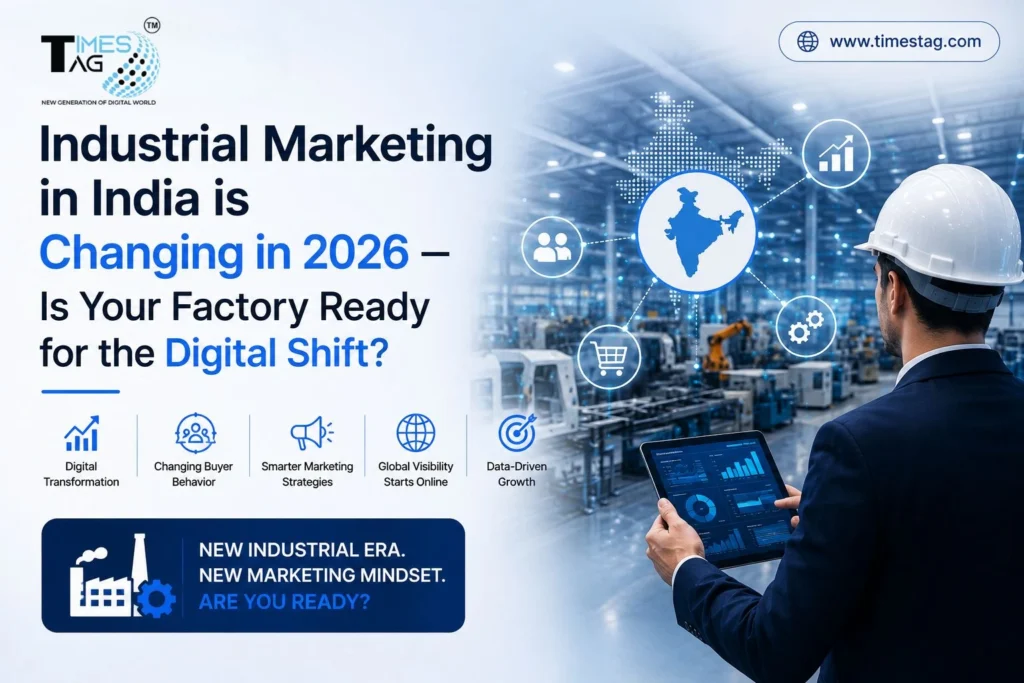
Twenty years ago, if you wanted to grow your manufacturing business, you had a clear playbook.
Attend the trade fair in Mumbai or Ahmedabad. Print a detailed product catalog. Get your sales team to make calls. Build relationships. Wait for referrals.
It worked. For a long time, it was the only game in town.
But something has shifted. And if you haven’t noticed it yet, your competitors certainly have.
The way industrial buyers in India find, evaluate, and select suppliers has fundamentally changed. The manufacturers who adapt to this change are quietly pulling ahead, getting enquiries, building pipelines, and closing deals with clients they never met at an expo.
This blog is about that shift. What’s driving it, what it looks like in practice, and most importantly, what you can do about it.
The Old Way Isn't Enough Anymore
Let’s be clear: trade fairs still work. Referrals still matter. Personal relationships in B2B will always carry weight.
But here’s what’s changed: buyers no longer wait for a sales rep to find them. They do their own research first, and they do it online.
According to DemandSage’s 2026 B2B Marketing Statistics report, 89% of B2B buyers now research products online before making a purchase decision. More significantly, OneMagnify’s B2B Digital Marketing Trends 2026 report reveals that by the time a buyer contacts a potential supplier, they are already 60–70% through their decision-making process. They’ve compared options, checked websites, read case studies, and shortlisted companies.
OneMagnify also highlights a critical behavioral shift: “Today’s decision-makers want to gather information independently. They rely on search engines, peer reviews, and third-party content to form opinions before ever engaging with a sales rep.”
If your business didn’t appear during that research phase, you weren’t in the conversation. And you’ll never know about the enquiry you lost.
Why India's Industrial Market Is Going Digital Right Now
India’s digital marketing market is expanding at an extraordinary pace. According to Expert Market Research, the India digital marketing market is projected to grow at a CAGR of 30.20% between 2026 and 2035, reaching approximately USD 93.94 billion by 2035. This growth is driven by rising internet penetration, mobile-first research behavior, and the changing profile of B2B decision-makers.
Balistro Consultancy’s 2026 Digital Marketing Trends for India adds important context: “India’s digital advertising market is projected to reach ₹62,000 crore by 2026, growing at 25% CAGR.” That explosive growth means more businesses — including your industrial competitors — are competing for digital attention than ever before.
Perhaps most importantly, a new generation of buyers is taking procurement seats. According to Shopify India’s B2B Ecommerce Trends 2026 report, Millennials and Gen Z now account for 73% of all B2B buyers. These are people who grew up researching everything online. They don’t start supplier selection with a phone call. They start with Google — and they expect your digital presence to match their standards.
What's Actually Changed: Old Way vs. New Way
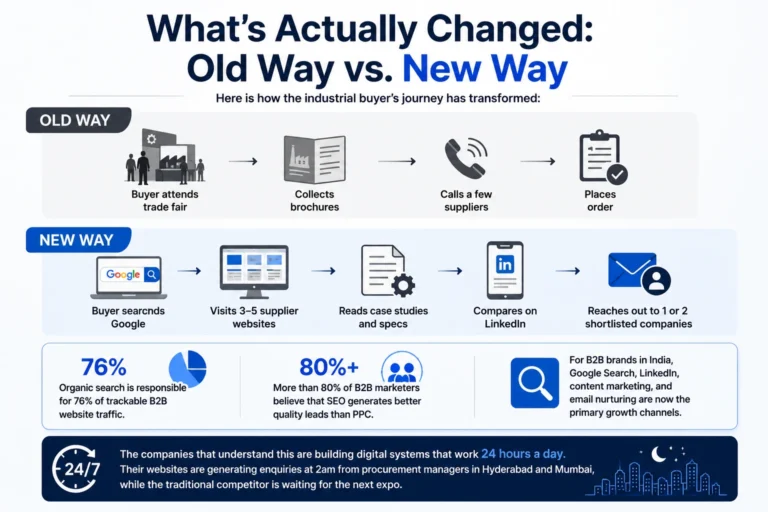
Here is how the industrial buyer’s journey has transformed:
Old Way: Buyer attends trade fair → Collects brochures → Calls a few suppliers → Places order
New Way: Buyer searches Google → Visits 3–5 supplier websites → Reads case studies and specs → Compares on LinkedIn → Reaches out to 1 or 2 shortlisted companies
Notice the difference? In the old way, the first point of contact was between the buyer and your sales team. In the new way, the first point of contact is between the buyer and your website.
DemandSage reports that organic search is responsible for 76% of trackable B2B website traffic. And more than 80% of B2B marketers believe that SEO generates better quality leads than PPC. That tells you where buyers are coming from — and where your visibility needs to be.
Balistro notes that for B2B brands in India specifically, “Google Search, LinkedIn, content marketing, and email nurturing” are now the primary growth channels — not trade events alone.
The companies that understand this are building digital systems that work 24 hours a day. Their websites are generating enquiries at 2am from procurement managers in Hyderabad and Mumbai, while the traditional competitor is waiting for the next expo.
The Industries Already Winning Online in India
This isn’t theoretical. We’ve seen it work directly with our clients at Times Tag.
Valve and fitting manufacturers who publish technical content around product applications and certifications are ranking for highly specific searches their competitors ignore. When a plant engineer searches “butterfly valve for chemical plant India,” the company with a detailed, keyword-optimized product page wins the enquiry.
Pneumatic equipment suppliers who invest in Local SEO appear when buyers search “pneumatic cylinder supplier Ahmedabad” or “compressed air accessories Gujarat.” Their Google Business Profile shows photos of their facility, real reviews, and verified contact details — which builds immediate credibility.
As the manufacturing SEO guide at HireSEOPro notes: “Manufacturing SEO rewards patience and precision. Do it right, and the enquiries that come in are far more qualified than any marketplace leads.”
Industrial plant manufacturers in sectors like biofuel and renewable energy are using content marketing and case studies to attract buyers specifically looking for project track records and proven expertise. As Mocaup’s B2B Digital Marketing Agency guide for 2026 explains, “Indian businesses are more likely to buy from you if they see a case study of a similar business in Jaipur, Mumbai, or Gurgaon” — localized proof is a conversion powerhouse.
What "Digital-First Industrial Marketing" Looks Like
A digital-first approach doesn’t mean abandoning everything that has worked. It means layering a digital presence on top of your existing strengths.
Here’s what the most effective industrial marketing systems in 2026 look like:
- A Well-Built, Technically Strong Website Your website is your 24/7 salesperson. ACSIUS’s Industrial SEO Guide confirms that a mobile-friendly website is now a key ranking factor, and that most industrial B2B buyers browse on mobile devices. It needs to load fast, look professional on mobile, and clearly communicate what you make, who you serve, and what makes you different.
- Search Engine Optimization (SEO) The Smarketers explain that for manufacturers, SEO means targeting “technical specification queries, application queries, and compliance queries — all lower volume but with much higher conversion intent than broad commercial terms.” This is how you show up when buyers are genuinely ready to enquire.
- Google Business Profile and Local SEO A B2B SEO specialist writing on Vocal/Geeks who has worked with multiple manufacturers in Gujarat puts it plainly: “If you have a textile business in Surat or make auto parts in Ahmedabad, you should appear on Google when people search in those areas.” Local SEO is one of the fastest ways to start generating digital enquiries for any Indian manufacturer.
- Content Marketing and Case Studies LinkedIn’s 2026 B2B Marketing Benchmark (via KLIQ Interactive) reveals that 94% of B2B marketers agree that trust is the key to success in B2B marketing. Case studies and technical content are the most reliable trust-builders — far more effective than generic advertising claims.
- Google Ads for Immediate Visibility Mocaup’s 2026 B2B agency guide recommends combining both approaches: “Start with a small paid ads budget to test which keywords and messaging converts, while simultaneously building content for long-term organic ranking. Paid ads give you data faster. SEO builds compounding value over 12 to 24 months. Neither channel alone performs as well as both reinforcing each other.”
The Risk of Waiting
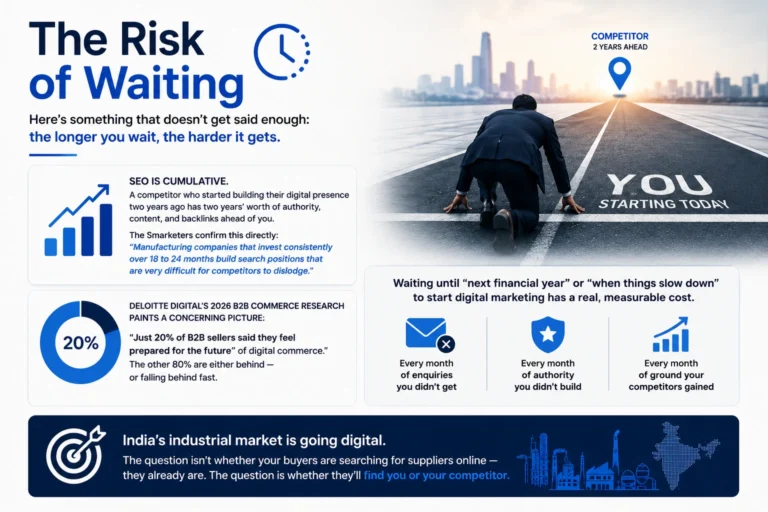
Here’s something that doesn’t get said enough: the longer you wait, the harder it gets.
SEO is cumulative. A competitor who started building their digital presence two years ago has two years’ worth of authority, content, and backlinks ahead of you. The Smarketers confirm this directly: “Manufacturing companies that invest consistently over 18 to 24 months build search positions that are very difficult for competitors to dislodge.”
Deloitte Digital’s 2026 B2B Commerce Research paints a concerning picture: “Just 20% of B2B sellers said they feel prepared for the future” of digital commerce. The other 80% are either behind — or falling behind fast.
Waiting until “next financial year” or “when things slow down” to start digital marketing has a real, measurable cost. Every month that passes is a month of enquiries you didn’t get, a month of authority you didn’t build, and a month of ground your competitors gained.
India’s industrial market is going digital. The question isn’t whether your buyers are searching for suppliers online — they already are. The question is whether they’ll find you or your competitor.
3 Steps to Modernize Your Industrial Marketing Today
You don’t have to change everything at once. Start here:
Step 1 — Audit Your Current Website: Does it load in under 3 seconds? Does it look good on mobile? Are your product pages detailed and clear? ACSIUS confirms these are baseline requirements for industrial SEO in 2026. If the answer to any is no, this is where you begin.
Step 2 — Claim Your Google Business Profile: If you haven’t done this yet, do it today. It’s free and improves your local visibility immediately. Add photos of your factory, your service area, product categories, and request reviews from current clients.
Step 3 — Talk to a Digital Marketing Agency That Understands Industrial Businesses: As Mocaup’s B2B guide notes, generic agencies apply “spray and pray” tactics. A specialized agency understands the B2B sales cycle, knows how technical buyers search, and has actually delivered measurable results for manufacturing companies.
Final Thoughts
Industrial marketing in India is changing — not slowly, but rapidly. DemandSage reports that 91% of B2B marketers now use content marketing and that digital strategies are the primary driver of B2B pipeline in 2026. The manufacturers investing in digital marketing right now are building a competitive advantage that will compound for years.
Your factory, your products, and your experience deserve to be found. Let’s make sure they are.
Book a Free Strategy Call with Times Tag. We specialize in digital marketing for Indian manufacturing companies.