




Let me ask you something, honestly.
You have a great product. Your factory has been running for years. Your existing clients love you. But when a procurement manager in Pune types “pneumatic valve supplier India” into Google, your website is nowhere to be found.
Sound familiar?
This is the reality for hundreds of manufacturing companies across India right now. They have decades of experience, real results, and genuine capability but they’re invisible online. And in 2026, being invisible online is the same as not existing.
At Times Tag, we’ve worked with industrial businesses like Airmax Pneumatics, Cair Euromatic, and Advance Biofuel. We’ve seen the same SEO mistakes repeat over and over again. This blog breaks them down and, more importantly, tells you exactly how to fix them.
The Problem Is Real, and It's Costing You Leads
Before we get into the mistakes, let’s understand what’s at stake.
B2B buying behavior has fundamentally changed. According to DemandSage’s 2026 B2B Marketing Statistics report, 89% of B2B buyers now research products online before making a purchasing decision. That means your next big client is searching Google right now, and if your competitor shows up and you don’t, that’s a lost enquiry you’ll never even know about.
Industrial buyers in 2026 are also more self-sufficient than ever. Research from OneMagnify’s B2B Digital Marketing Trends 2026 reveals that many buyers are already 60–70% through their decision-making process before they ever reach out to a vendor. They’ve already compared suppliers, checked websites, read case studies, and shortlisted options. If you weren’t in their search results during that research phase, you weren’t considered.
And it gets more specific than that. A March 2026 Gartner report referenced by Danetsoft found that 67% of B2B buyers now prefer a rep-free buying experience, meaning they want to research, compare, and shortlist suppliers before ever speaking to a salesperson. Your website is doing the selling, whether you’ve prepared it for that job or not.
The stakes couldn’t be higher. So why do so many manufacturing companies still fail at SEO?
Mistake #1: Targeting the Wrong Keywords
This is the most common and most damaging mistake we encounter.
Most manufacturing websites optimize for terms like “best manufacturer India” or “quality industrial products.” These are what we call brand-ego keywords; they feel good to rank for, but they don’t attract serious buyers.
Real industrial buyers search with precision. As Nopio’s B2B SEO for Manufacturing guide explains: “A keyword with 50 monthly searches might seem unimpressive — until you realize each searcher represents a potential six-figure contract.” Buyers type things like:
-
- “double-acting pneumatic cylinder 50mm bore”
-
- “moisture separator for compressed air Ahmedabad”
-
- “ISO certified valve manufacturer Gujarat”
The Smarketers, India’s first ITSMA-awarded ABM agency, explains this clearly: “Manufacturing SEO is specification-led. Buyers search for specific performance attributes, material properties, compliance certifications, and application requirements rather than brand names.”
Sana Commerce’s SEO for Manufacturers guide also points out that low-to-no-volume keywords in manufacturing are a major missed opportunity because these terms attract users who are actively ready to make purchasing decisions, not casual browsers.
The Fix: Sit down with your sales team. Ask them: “What exact questions do our clients ask before they place an order?” Those questions are your best keywords. Build dedicated pages around each product specification, application, and use case.
Mistake #2: Thin, Unhelpful Product Pages
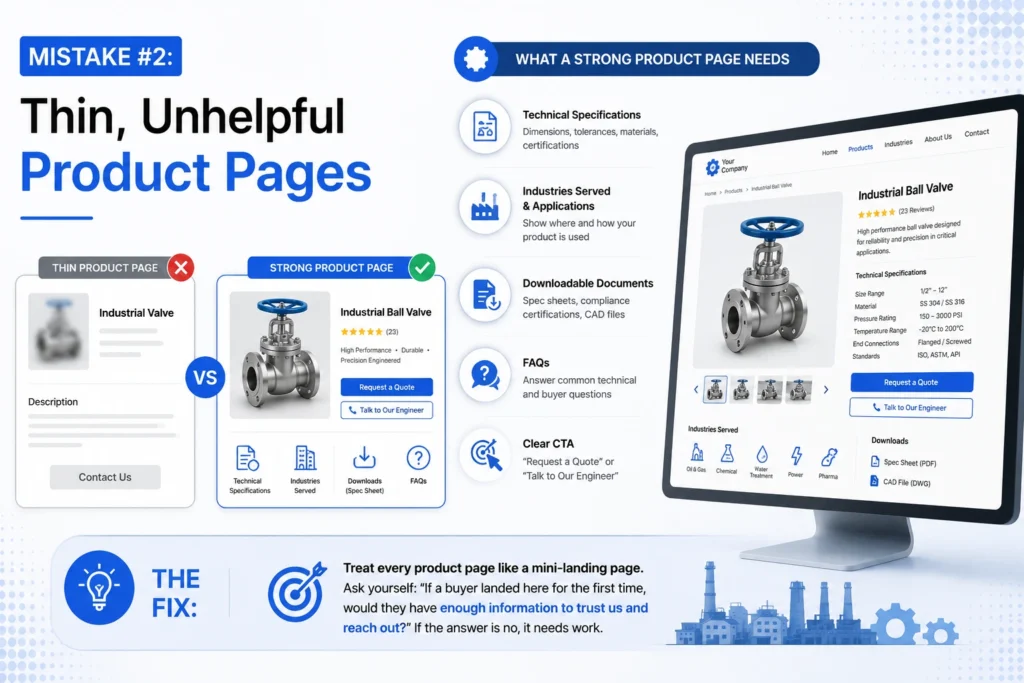
Walk through most manufacturing websites, and you’ll see the same thing — a product page with a blurry image, three lines of generic description, and a contact form. That’s it.
Danetsoft’s guide for industrial manufacturers lists this as one of the six most common mistakes stopping manufacturers from ranking: “Publishing thin product pages that lack specifications, industries served, FAQs, and quote prompts.”
The Smarketers’ manufacturing SEO research confirms this: standard shallow product pages do not rank well for industrial specification queries. What works is product pages with integrated technical data, downloadable specs, compliance documentation, application guidance, and engineering FAQs.
Sana Commerce adds another critical point: “It’s crucial to ensure that your product pages are well-structured, informative, and optimized with relevant keywords. Weak product pages lacking detailed descriptions, specifications, and unique selling points will negatively impact your search engine rankings.”
What a strong manufacturing product page needs:
-
- Technical specifications (dimensions, tolerances, materials, certifications)
-
- Industries served and specific applications
-
- Downloadable spec sheets or compliance documentation
-
- FAQs addressing buyer concerns
-
- A clear CTA — “Request a Quote” or “Talk to Our Engineer.”
The Fix: Treat every product page like a mini-landing page. Ask yourself: “If a buyer landed here for the first time, would they have enough information to trust us and reach out?” If the answer is no, it needs work.
Mistake #3: Zero Technical SEO Foundation
This one is invisible to most business owners — but it quietly kills rankings every single day.
ACSIUS’s Industrial SEO Guide for 2026 is direct: “Industrial SEO in 2026 is more advanced, competitive, and rewarding than ever before. Businesses that invest in strategic SEO practices can achieve higher rankings, increased visibility, and stronger customer relationships.” That competitive environment means technical health is no longer optional.
A B2B SEO expert writing for Vocal/Geeks describes what they find constantly on manufacturing websites: “Duplicate content across similar product categories, missing descriptions, websites that look terrible on phones, and PDF spec sheets that take forever to load.”
Danetsoft explicitly names “neglecting technical SEO by allowing slow pages, broken links, poor mobile layouts, or crawl errors” as one of the top six reasons manufacturers fail to rank. And ACSIUS confirms that mobile-friendliness is now a key ranking factor, since a large portion of industrial buyers browse on mobile devices.
The Fix: Run a free audit using Google Search Console. Check for Core Web Vitals score, mobile usability issues, crawl errors, and page speed. Fix these first before spending money on content or link building. A fast, mobile-friendly, error-free website is the foundation on which everything else is built on.
Mistake #4: Ignoring Local SEO Completely
If you’re a manufacturer in Ahmedabad, Rajkot, Pune, or Coimbatore, local SEO is not optional. It’s one of your biggest and most underused opportunities.
A B2B SEO professional writing on Vocal/Geeks who has worked extensively with manufacturers in Gujarat states: “If you have a textile business in Surat or make auto parts in Ahmedabad, you should appear on Google when people search in those areas.” They add: “I have also worked with many manufacturers in Gujarat to boost their traffic and help them generate quality leads by focusing on locally-based keywords.”
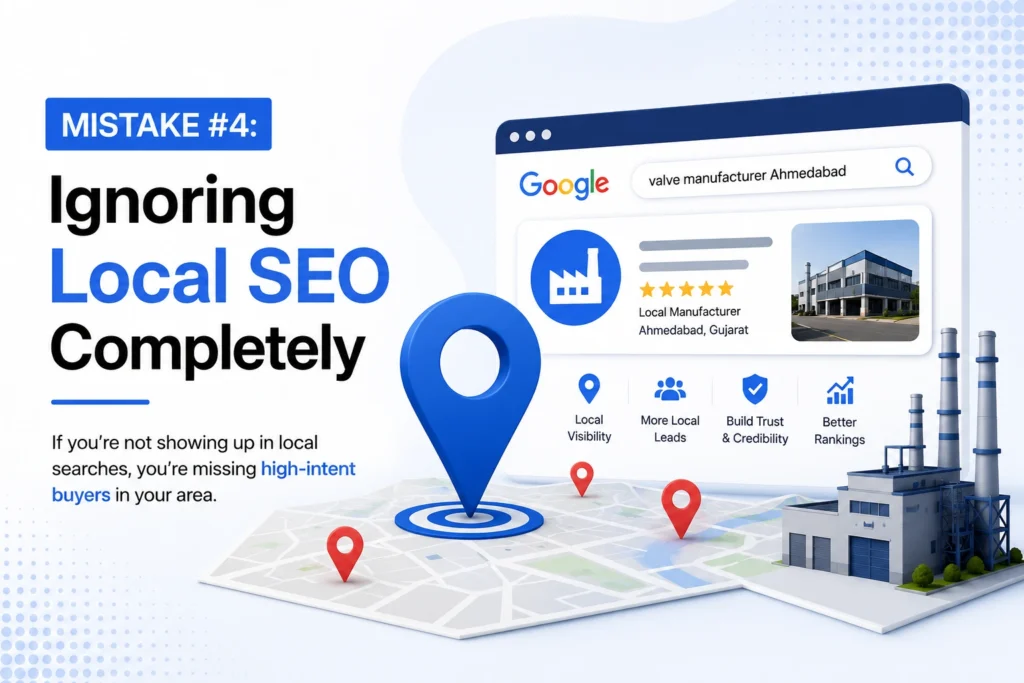
The manufacturing SEO specialist at HireSEOPro reinforces this trust dimension: “Your factory location builds trust. Even US buyers check whether a manufacturer looks real. Local authority strengthens global SEO.”
Your verified Google Business Profile — with photos of your facility, real client reviews, and updated contact information builds credibility instantly. Buyers who search “valve manufacturer Ahmedabad” and find your listing with 15 genuine reviews are far more likely to enquire than to click through to a faceless website.
The Fix: Claim and fully optimize your Google Business Profile. Add photos of your factory, products, and team. Collect reviews from existing happy clients. Use location + product keywords naturally throughout your website.
Mistake #5: No Content, No Blog, No Authority
This is the silent killer of manufacturing SEO.
Most manufacturers think, “We’re not a lifestyle brand — why would we need a blog?” The answer is simple: Google ranks websites that demonstrate expertise, not just websites that exist.
mktgessentials’ SEO for Industrial Manufacturing guide explains Google’s E-E-A-T framework as it applies to manufacturers: “Focus on content quality, not quantity. Educate your audiences first, sell second. Showcase your expertise and depth of knowledge. Understand your target audiences and how to cater your content to their concerns.”
The manufacturing SEO specialist at HireSEOPro is refreshingly honest: “Blogging alone won’t get you B2B enquiries. But technical blogs absolutely help. These blogs build topical authority and support your core pages.”
Case studies, specifically, carry enormous SEO and conversion weight. A B2B SEO expert on Vocal/Geeks explains: “Search engines love detailed case studies that demonstrate what you can actually do as a manufacturer. They not only help with SEO but also convince potential customers to contact you. They should tell the story of specific manufacturing problems you solved and include actual numbers.”
The Fix: Start with one blog per month. Focus on the questions your sales team hears repeatedly. Use your own project results as the basis for case studies. Link every blog back to your product and service pages to build internal authority.
Case Study: How This Approach Worked for Airmax Pneumatics
Airmax Pneumatics came to us with a strong product line but almost no organic visibility. Their website had thin product pages, no blog content, and poor technical health.
We rebuilt their product architecture, added technical depth to key pages, set up their Local SEO, and launched a content strategy built around buyer-intent keywords. The results were measurable, significant improvements in organic traffic, and a consistent flow of qualified enquiries through their website. You can read the full Airmax case study here.
The same approach delivered results for Cair Euromatic and Advance Biofuel. The principles never change: fix the foundation, build for the buyer, publish with consistency.
As ACSIUS summarizes perfectly: “Industrial SEO is not a one-time effort; it’s an ongoing process. Consistency and adaptability are key to long-term success.”
The 5-Step SEO Fix for Manufacturers
Step 1 — Keyword Research: Use your sales team’s knowledge to find buyer-intent, specification-driven keywords. Tools like SEMrush and Moz can help, as recommended by mktgessentials.
Step 2 — Fix Technical SEO: Audit site speed, mobile-friendliness, and crawl errors using Google Search Console. Fix Core Web Vitals first.
Step 3 — Rebuild Product Pages: Add technical depth, specs, applications, FAQs, and a strong CTA on every product page, as advised by The Smarketers.
Step 4 — Set Up Local SEO: Optimize your Google Business Profile and integrate location-based keywords, as detailed by Vocal/Geeks.
Step 5 — Publish Content Regularly: Start a technical blog and build case studies from real project work, linking all content back to core product pages.
Final Thoughts
Manufacturing SEO requires consistency and the right strategy. The Smarketers put it well: “Technical specification pages can start ranking within 3 to 6 months for lower-competition queries. Building topical authority typically takes 6 to 12 months of consistent content investment.” The compounding nature of SEO means that manufacturers that invest consistently over 18–24 months build search positions that are very difficult for competitors to dislodge.
The companies that start now will own their search rankings for years. The ones that wait will find themselves playing catch-up.
Get a Free SEO Audit for Your Manufacturing Business from Times Tag.